
Keep your cash in your pocket!
Understanding and Using a Bill of Exchange to Legally Settle Bills Issued by Government or Corporate Entities Without Spending Your Hard-Earned Cash
What Is a Bill of Exchange?
Legal Definition: A bill of exchange is an unconditional order in writing, addressed by one person to another, signed by the person giving it, requiring the person to whom it is addressed to pay on demand, or at a fixed or determinable future time, a sum certain in money to or to the order of a specified person, or to bearer.
(See the official legal definition here: Bills of Exchange Act 1909 – Section 8)
A bill of exchange cheque is essentially a written, legally enforceable order issued by one party (the drawer) instructing a bank or financial institution (the drawee) to pay a specified amount of money to a designated person or entity (the payee), either immediately or at a future date. It combines the characteristics of a bill of exchange—a formal negotiable instrument used in trade—and a cheque, which is a direct order to a bank to pay on demand.
Historically, this concept is not new. Bills of exchange have been used in commerce for centuries to facilitate transactions without the immediate exchange of cash. Banks operate using bills of exchange and promissory notes as part of the commercial and financial system. The banknotes in your wallet are also forms of negotiable instruments recognised within the monetary system.
Drawer and Drawee Definitions
- A drawer is the person or entity who creates, signs, and issues a negotiable instrument—such as a cheque or bill of exchange—ordering a drawee (typically a bank) to pay a specific sum of money to a payee.
- The drawer is the account holder who authorizes the transfer of funds.
Key Aspects of a Drawer
- Definition: The maker of a bill of exchange or cheque.
- Role: The person who initiates the payment by writing and signing the instrument.
- Liability: The drawer is responsible for ensuring the instrument is paid. If the drawee dishonours it, the drawer is generally liable to the holder.
- Context: In a cheque transaction, the drawer is the account holder, the drawee is the bank, and the payee is the recipient.
Key Differences
- Drawer vs. Maker: In bills of exchange and cheques, the creator is called a drawer. In promissory notes, the creator is called a maker.
- Drawer vs. Drawee: The drawer orders the payment; the drawee (usually a bank) makes the payment.
Key Differences:
- Drawer vs. Maker: In bills of exchange/checks, it is a drawer. In promissory notes, the creator is called a maker.
- Drawer vs. Drawee: The drawer orders the payment; the drawee (bank) makes the payment.
How Does a Bill of Exchange Work?
Glossary of Terms
- Authority to Process: A document that should accompany each Bill of Exchange, available for download below.
- Bill of Exchange (BoE): A written, unconditional order issued by one party (the drawer) directing another party (the drawee) to pay a specified amount to a third party (the payee), or to the bearer, either on demand or at a fixed future date, as governed by the Bills of Exchange Act 1909 (Cth).
- Case Law: Legal precedents established by court decisions, used to interpret and apply laws such as the Bills of Exchange Act 1909.
- Drawee: The party directed by the Bill of Exchange to make payment, typically a bank or an entity owing money to the drawer.
- Drawer: The party who issues the Bill of Exchange, ordering the drawee to pay the specified amount to the payee.
- FOI Requests: Freedom of Information requests made to government agencies (such as the Attorney-General) to access documents or confirm legal positions, including the applicability of the Bills of Exchange Act 1909.
- GovCorp: A shorthand term used to describe government and corporate entities making financial demands, such as taxes, fines, or bills.
- Legal Tender: Currency or coinage that must be accepted if offered in payment of a debt, as defined by the Currency Act 1965 (Cth) in Australia, including Australian dollar notes and coins. Refer to the Governor of the Bank of England desription of Legal Tender.
- Payee: The party to whom payment is directed in a Bill of Exchange, either a specified person or the bearer of the document.
- Paper Trail: A record of documents and communications, including copies of Bills of Exchange, mailing receipts, and correspondence, kept as evidence in legal or financial disputes.
Got Questions? Join Mike any Thursday at one of these times:


Simplified Steps to Create a Bill of Exchange
This is very important:
1. Scan or photograph the original Bill as soon as you get it and keep the printout in a folder dedicated to each Bill of Exchange
2. Always keep copies and create a paper trail
3. Proof of receipt for the BoE you send back to GovCorp is your safety net.
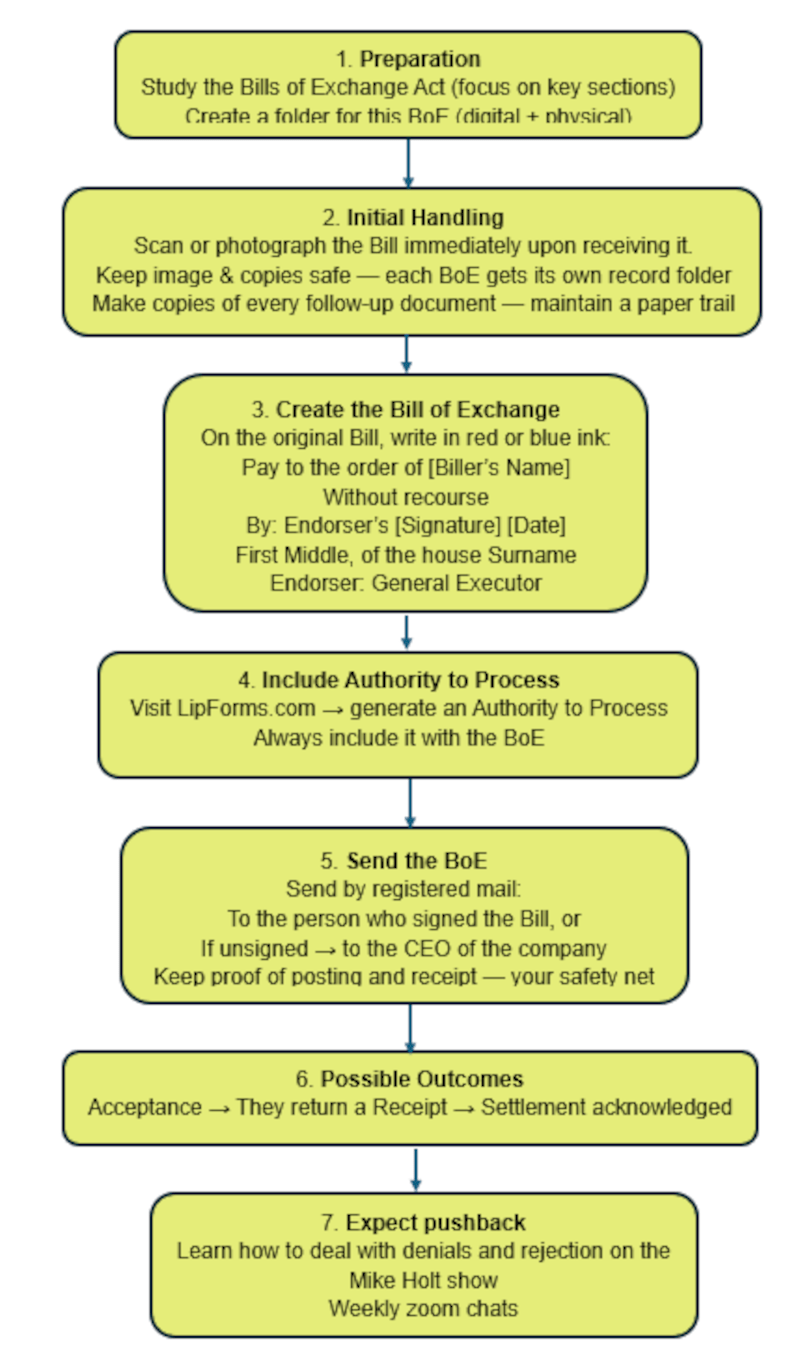
Join the Zoom chat every Thursday to ask questions and meet others. Click below!
Follow these steps each time you create a Bill of Exchange:
Before you begin, study the Bills of Exchange Act 1909 and familiarize yourself with its most important sections.
If you are in the USA, the Uniform Commercial Code (UCC) applies. Most other countries also have their own Bills of Exchange legislation, so make sure you read the applicable Act for your jurisdiction and quote directly from it in your responses where appropriate. We have collected Bills of Exchange legislation from many countries, listed below.
If you want to identify equivalent sections between the Australian Bills of Exchange Act and your country’s legislation, you can ask an AI question such as:
“What are the equivalent sections in my country’s Bills of Exchange legislation to the Australian Bills of Exchange Act 1909?”
Creating a Paper Trail
As soon as you receive a bill, immediately make a copy of it, use the original to create your BOE, and keep a copy of it with you papter trail.. Also make copies of every follow-up document, including both their correspondence and yours. Keep all records carefully to create a complete paper trail.
Creating Your Bill of Exchange
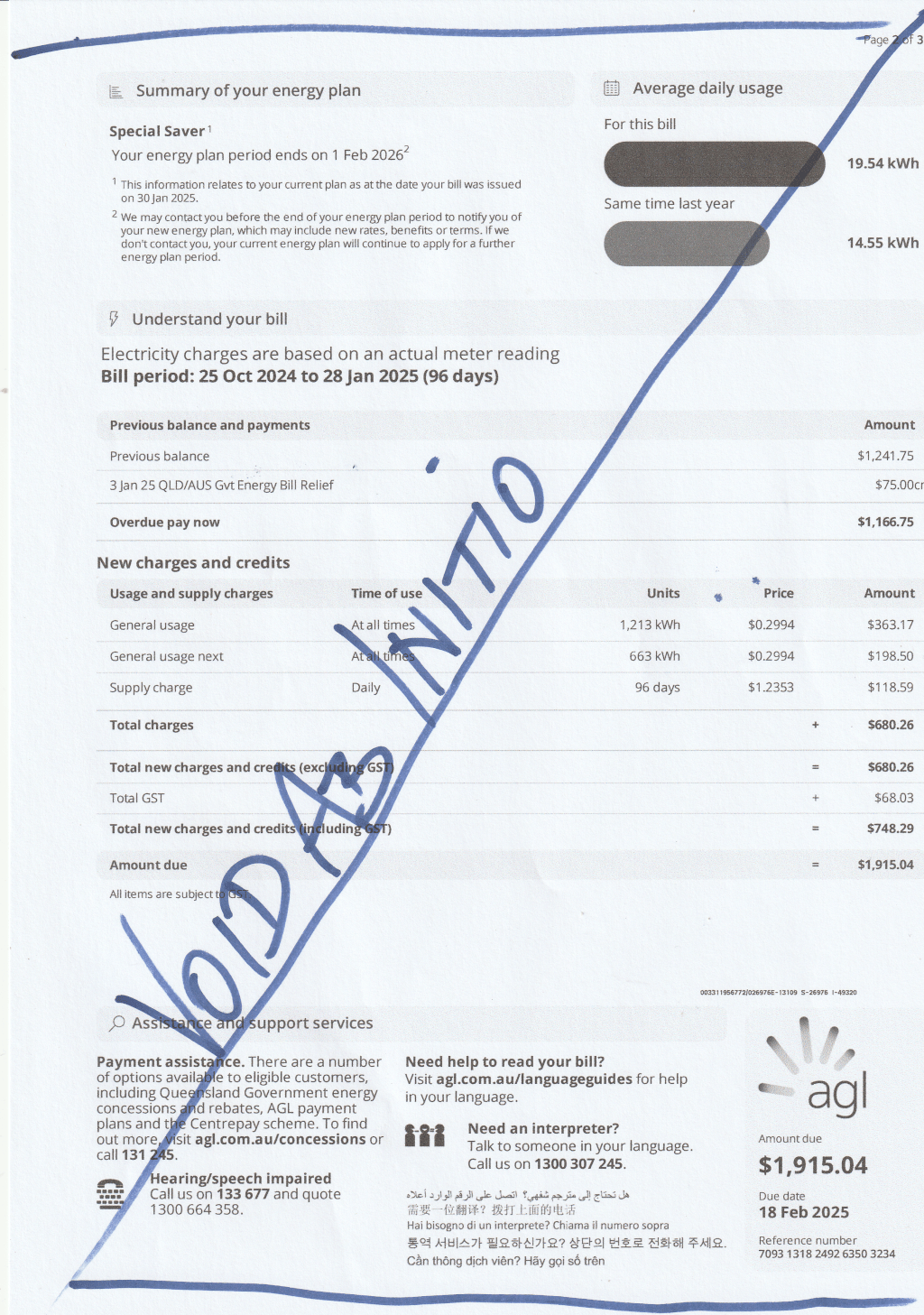
Create your Bill of Exchange by endorsing the original bill using red, purple or blue ink as follows:
BILL OF EXCHANGE
Pay to the order of [Biller’s Name]
Without recourse
By: Endorser: [sign with your usual Signature] [Date]
First Middle, of the house Surname [Use sentence case]
Endorser, General Executor
Authority to Process: Scroll down below to download and print the first downloadable document, titled “Authority to Process.” Always include this document with any Bill of Exchange you create.
- Write a Cover Letter to explain what you are sending.
- Sending the Documents: Always send the Bill of Exchange and any accompanying documents by registered mail. Address the documents to the person who signed the original bill. If there is no signature, send them to the CEO or authorized officer of the company. If there are two or more company owners or managers, only one needs to sign the Bill of Exchange.
- Waiting for a Response: After sending the documents, wait for their response. Under the Bills of Exchange framework, a response may include acceptance, rejection, or other correspondence. Keep copies of all communications for your records.
- Acceptance or Rejection: Once you lodge and register the letter containing your Bill of Exchange at the post office, keep the registration and delivery records as evidence of mailing and delivery. When you register the letter containing your BOE, it is considered ‘accepted’, as the billing party must sign for the letter when it is delivered by the Post Office.
- Review: You should review Sections 47 and 48 of the Bills of Exchange Act 1909 regarding dishonour and notice requirements, and also review information published by the Bank of England on Legal Tender.
- Maintain your Paper Trail: Different organizations may have differing policies or legal interpretations regarding Bills of Exchange and their acceptance. If you receive a rejection or dispute, maintain your paper trail and join the Mike Holt Show weekly Zoom chat.
- Settlement: If there is no response, or if the recipient disputes or rejects the Bill of Exchange, retain all correspondence and mailing records as part of your evidence file.
- Know the Law: You should independently review Sections 47 and 48 of the Bills of Exchange Act 1909 and any relevant case law in your jurisdiction to understand how those provisions may apply to your circumstances.
Know the most important sections of the BoE Act
Using ChatGPT AI to find the equivalent sections in your Bills of Exchange Act:
The AI Prompt to type: (copy paste the following into AI)
- BILLS OF EXCHANGE ACT 1909 – SECT 08 – Bills of Exchange defined
- BILLS OF EXCHANGE ACT 1909 – SECT 22 – Definition and requisites of acceptance
- BILLS OF EXCHANGE ACT 1909 – SECT 24 – General and qualified acceptances
- BILLS OF EXCHANGE ACT 1909 – SECT 25 – Inchoate instruments
- BILLS OF EXCHANGE ACT 1909 – SECT 26 – Delivery
- BILLS OF EXCHANGE ACT 1909 – SECT 35 – Presumption of good value and faith
- BILLS OF EXCHANGE ACT 1909 – SECT 36 – Negotiation of bill
- BILLS OF EXCHANGE ACT 1909 – SECT 47 – Non-acceptance
- BILLS OF EXCHANGE ACT 1909 – SECT 48 – Dishonour by non-acceptance and its consequences
- BILLS OF EXCHANGE ACT 1909 – SECT 50 – Rules as to presentment for payment
- BILLS OF EXCHANGE ACT 1909 – SECT 66 – Acceptor the holder at maturity
- BILLS OF EXCHANGE ACT 1909 – SECT 68 – Cancellation
- BILLS OF EXCHANGE ACT 1909 – SECT 70 – Acceptance for honour supra protest
An Example of what to write on a Bill:

Proof it Works
- Go to our Home page and click on Add your Testimonial to add your success story for everyone to see.
- Read the many success stories on Telegram (LIP) section Winners & Grinners.
Know the Law
All government agencies that issue Bills to private people, such as councils, electricity and water providers, operate under corporate rules, but like all Australians they must OBEY all our laws. GovCorp demands for you to pay their bills lack legitimacy without a Jury Trial (See the Magna Carta and English Bill of Rights 1689, making a BoE a lawful countermeasure. We use their laws to stop their corruption and force them act as the PUBLIC SERVANTS they are.
Employees can stop automatic withholding tax from your salary or wage
The ATO provides a form you can download, fill out and hand to your boss to tell him to stop deducting withholding tax from your salary or wage. Click on the link and go to the ATO website to learn how this form works and to download it:
https://www.ato.gov.au/forms-and-instructions/withholding-declaration
What can go wrong:
- Agencies might ignore the BoE and escalate (e.g., license suspension or even court). Do not fear this. Use it as an opportunity to challenge their decision, and threaten to take them to court for breaking their own laws.
- Legal recognition varies – courts may not always uphold this tactic, but if you go prepared with all the documents in your paper trail you have an excellent chance of winning. A win is a precedent everyone else can use. However, it is unlikely they will want to go to court, as a loss could collapse the whole system. There have been many reports that their casees were settled out of court instead.
When GovCorp Refuses to Honour your BoE
- Billers may sometimes indicate that they do not accept or recognise a Bill of Exchange. In many cases, this can be due to differing internal policies, limited familiarity with the instrument, or standardised billing procedures.
- Read their documents carefully, identify any Claims they make, and challenge those claims. This holds them accountable for their responses and challenges them to act legally.
- The key approach is to remain consistent, clear, and professional in all communications. Treat the process as a formal correspondence matter rather than a point of conflict.
- Where an organisation states that it does not accept Bills of Exchange, you may respond in writing requesting clarification of their position, including whether they are relying on any specific statutory exemption or internal policy in relation to the Bills of Exchange Act.
- Maintaining a clear paper trail of all communications is important. Keep copies of all letters sent and received, along with proof of posting and delivery.
- You may use structured response letters to request clarification and ensure that all parties have a consistent understanding of the process being followed.
- Whenever you are approached by a Bill Collector, always ask for the Deed of Assignment of the debt. If they don’t have it, they cannot harass you. Tell them to bugger off!
ALWAYS Send this letter with each BOE you send. Fill in the details marked in red with the information from each Bill presentment and then change the font colour to Black:

Each time you create a Bill of Exchange, print out this letter, fill in the information shown in RED, and after editing make sure you change the font color to black, and Save as… so that you retain this template ready for each use. The template is in MS Word Format, but it also works in most other word processors.
First Response: If the organization refuses your BoE, stating they do not accept this form of payment, send this letter.

Download and edit any text in RED and when finished editing make sure you change the font color to Black. This letter explains the Bills of Exchange Act law to GovCorp officers, and asks them to prove they are exempt from the law. Make sure to include the a copy of your original BOE and mark it COPY, and include the FOI letter from the Attorney General’s Office as well.
Second Response: If they continue to refuse to process your BoE, download and send this letter:
Download and use this template letter when a company that you have already sent a Bill of Exchange to refuses to accept it, claiming they do not recognize Bills of Exchange. They are after your cash. But they have no right to it, so never give in and pay them with your cash. By denying them our cash we are weakening their illegal system. It’s up to each one of us to fight back.
If the Biller continues to deny their fiduciary duty, send this letter to warn them that they are responsible:
Download and amend all red text, and send this letter after the 2nd Response Letter.
This letter is often the final time you will need to write to them. If they still refuse to accept responsibility you should prepare to go to court:
Send this letter whenever a utility company, council or other GovCorp organization continues to refuse to process a Bill of Exchange.
But before you go to court, send this letter.
Download and amend everything in red. Send this after the Biller still refuses to deal with your BOE after sending the 1st and 2nd letters, followed by the Notice of Liability. If these do not work, a Cease and Desist letter usually settles the metter.
Click the link below to find FOI Requests to Country Attorney Generals confirming no government agency is exempt from the Bills of Exchange Act:

Got Questions? Click here…

What to do if GovCorp decides to take you to court
- Case law relating to Bills of Exchange generally addresses issues such as formation, acceptance, liability, and dishonour of negotiable instruments under the Bills of Exchange Act. For example, Bank of Australasia v Hall (1907) 4 CLR 1514 is sometimes referenced in discussions concerning principles of acceptance and liability in negotiable instruments.
- When dealing with disputes involving Bills of Exchange, it is important to rely on clearly relevant statutory provisions and applicable case law, and to ensure that any authorities cited directly support the specific legal issue being argued.
- If matters proceed to court, parties should be prepared with properly organised documentation and a clear understanding of the legal framework governing negotiable instruments, including the relevant provisions of the Bills of Exchange Act and supporting jurisprudence.
- Prepare 3 copies of your paper trail, and when you are summoned to court, give one copy to the Registrar before going into the courtroom and ask them to add your evidence to your case file. Hand the 2nd copy to the prosecuting lawyer, and retain your own copy in case you need to refer to them.
- Courts determine outcomes based on the correct application of law to the facts presented, so accuracy, relevance, and proper legal framing of arguments are essential.
- Never go to court and attempt to use the Strawman argument. You are not there to establish your common law existence. You are in court to enforce a valid financial instrument as settlement for a debt created by a government agency.
Prepare to Challenge Council Rates Home Repossession:
If a local council is threatening to take your property to pay for their claimed unpaid Rates, you need these documents. Download the template documents applicable to your state and use the documents to prepare to go to court.

Preparing to go to court: Documenting and Preparing Your Record
We have provided Freedom of Information (FOI) responses on this page. Include a copy of any relevant response from the Attorney-General’s Department or other government agency if GovCorp attempts to claim they do not accept Bills of Exchange.
Compile a complete record of your matter, including:
- copies of any Bills of Exchange or financial documents exchanged
- all correspondence between you and the relevant organisation
- any responses received, including letters rejecting or disputing your documents
- proof of posting and delivery records where applicable
Maintaining a complete and chronological file assists in clearly presenting the sequence of events if the matter requires further review.
Reference Materials
- You must know the laws you are referring to before you go to court. You will be facing professional prosecutor lawyers and they will use the law against you. If you don’t know the law, you may lose.
- Where legislation is being referenced, ensure you are working from the official version applicable in your jurisdiction. For example, the Bills of Exchange Act 1909 (Cth) is available through official legal databases such as AustLII. We have also provided a list in this page of the most important sections you need to know.
- If reviewing comparative legislation in other jurisdictions, ensure you use official statutory sources to identify equivalent provisions. Any comparative analysis should be verified against the relevant legislation rather than relying solely on secondary summaries or informal interpretations.
Court Preparation and Presentation of Information
If a matter proceeds to court or formal hearing, it is important to focus on presenting clear, relevant, and well-organised evidence.
Courts generally require:
- factual, chronological presentation of documents
- reliance on relevant statutory provisions and case law
- clear explanation of how documents relate to the issue in dispute
Legal arguments are assessed based on applicable law and evidence presented in the specific jurisdiction.
Dealing with Disputes or Legal Characterisation Issues
In disputes, parties may disagree on the legal effect or classification of financial documents. These issues are resolved by reference to applicable legislation, case law, and the facts of the individual matter.
It is generally appropriate to:
- request clarification of the legal basis for any position taken by another party
- maintain written records of all communications
- ensure arguments remain focused on relevant legal and factual issues
Important Considerations
- Legal systems vary between jurisdictions, and outcomes depend on the specific facts, applicable legislation, and judicial interpretation.
- Individuals are encouraged to ensure they understand the relevant legal framework or seek qualified legal advice where appropriate before relying on any particular interpretation of financial instruments or statutory provisions.
KNOWLEDGE IS POWER! GET THE POWER AND BE CONFIDENT
Final Thoughts
- As knowledge of financial instruments and relevant legislation increases, confidence in understanding and applying the law also tends to improve. Confidence in this context comes from being able to clearly identify the legal framework, relevant statutory provisions, and the facts of a particular situation.
- When dealing with government or corporate billing processes, it is important to understand the legal nature of any document received and how it is treated under applicable legislation. Responses and outcomes will depend on the specific facts, relevant statutory requirements, and the policies and procedures of the issuing organisation.
- Using a Bill of Exchange within a commercial or administrative context involves engaging with established legal mechanisms under the Bills of Exchange Act and related commercial law. The practical outcome of any process depends on proper execution, compliance with legal requirements, and the response of the other party.
- In all cases, maintaining accurate records, understanding the applicable law, and communicating in a clear and structured manner are key elements of effective engagement.
- Persistence, accuracy, and attention to detail are generally important when dealing with formal financial or administrative disputes.
This is very important. Read it!
If you’re intrigued, start small. Test it on a small fine or utility bill first
and build up your confidence
Must Watch Videos
These videos explain how BoEs work. Watch them at least once each. They share invaluable information:
Richard Vobes explains how your birth certificate works: The Trust is in your name. Grab it!
And here is another brilliant example from Richard Vobes of how to deal with Council demands for your money.
South African Michael Tellinger explains how Bills of Exchange work
Visit his website here. It’s fascinating. https://www.michaeltellinger.com/
Michael Tellinger and Scott Cundill discuss the fascinating story about Banks and the Global Banking Scam — Published: 7 March 2023
Would you like to have a handy reference? Get this e-Book in PDF format and read it any time.

References:
Here’s where to find your country’s Bills of Exchange Act. If yours is not listed, please send us the link to your country’s Bills of Exchange Act and send it to us to publish here: mike@mikeholtshow.com
- The Australian Bills of Exchange Act 1909
- Belgium Lawbook of Economics’. Article VII.216: It is in Dutch, but the Belgian legislature for the Bill of Exchange is in a lawbook called (translated) ‘the Lawbook of Economics’. Article VII.216 is all about the bill of exchange (in Dutch: “Wisselbrief”). Use ctrl+f search function to find the chapter
- Belgium Bill of Exchange Act (Dutch)
- Canada Bills of Exchange Act
- Cyprus Bills of Exchange Law
- Danish Bill of Exchange Act
- Estonia Bills of Exchange Act – Võlaõigusseadus
- France Code de Commerce
- Gibraltar Bills of Exchange Act
- India THE NEGOTIABLE INSTRUMENTS ACT, 1881 (PDF)
- Ireland Bills of Exchange Act
- Jamaica Bills of Exchange Act
- New Zealand Bills of Exchange Act
- Norwegian Bill of Exchange Act 1932
- Poland Bill of Exchange Act
- Romanian Bill of Exchange Act – Law #58/1934
- South Africa Bills of Exchange
- Spanish Bills of Exchange Act 1985
- Swedish Bill of Exchange Act
- Slovenia Bills of Exchange Act
- Tonga Bills of Exchange Act 1988 (Revised)
- UK 1882 Bills of Exchange Act
- US Bill of Exchange – NOTE: The United States does not have a single federal “Bills of Exchange Act” in the same way that some other countries do, such as the UK’s Bills of Exchange Act 1882. Instead, the law governing negotiable instruments, including bills of exchange, is primarily found in the Uniform Commercial Code (UCC) adopted by individual states. The UCC Article 3, in particular, governs negotiable instruments, including bills of exchange.
Key Things to Know:
Managing Financial Accounts and Communication with Organisations
- Where an individual has an ongoing payment arrangement such as a loan, mortgage, or instalment plan, it may be appropriate to request a consolidated statement or account summary from the organisation. This can help clarify the outstanding balance, including any applicable interest, fees, or early settlement amounts where relevant.
- Before sending a Bill of Exchange, cancel any ongoing deductions from your bank account. You don’t want the Biller to continue to take your cash after you settle an account with a BOE.
- Organisations will generally have internal procedures for providing payout figures or settlement quotes upon request.
Communication and Record Keeping
It is important to maintain a clear written record of all communications relating to financial accounts or disputes.
This may include:
- copies of letters sent and received
- emails and written responses
- notes of telephone conversations (including date, time, and content)
- proof of posting and delivery where applicable
Where clarity is required in a dispute, written communication is generally preferable because it creates a verifiable record.
Methods of Communication
- You should always request that correspondence be provided in writing.
- However, organisations may still use multiple communication channels unless both parties agree otherwise or a specific legal requirement applies.
- If a telephone call occurs and written communication is preferred, it is reasonable to state that you do not wish to speak on the phone, and request that future correspondence be provided in writing so that an accurate record can be maintained. Then hang up. Do not give them time to argue. You are within your rights to specify how the government communicates with you.
Handling Financial Documents
- It is generally good practice to keep copies or scans of any financial documents received for your own records.
- Any response to a financial document should be based on its content, the applicable agreement, and relevant law or policy.
Bills of Exchange and Legal Instruments
- Bills of Exchange are recognised financial instruments under the Bills of Exchange Act 1909 (Cth) – AustLII and similar legislation in other jurisdictions.
- The legal effect of any instrument depends on its proper creation, acceptance, and enforcement in accordance with the requirements of the applicable legislation and the facts of the specific transaction.
- If there is a dispute about the validity or effect of a financial instrument, this is typically resolved by reference to:
- statutory requirements
- contractual arrangements
- and relevant case law
Dispute Resolution and Clarification
- Where a party does not accept or recognises a financial instrument, it may be appropriate to request clarification of their position, including reference to any internal policy or legal basis relied upon.
- All communications should be retained as part of a complete record of the matter.
Key Considerations
- Financial disputes are resolved based on applicable law, contractual obligations, and evidence presented in each case.
- Outcomes depend on jurisdiction, documentation, and the specific circumstances involved.
- Individuals are encouraged to ensure they understand the relevant legal framework or seek appropriate professional advice when dealing with complex financial matters.
Did you find this article useful?
Please share it with your family, friends, and colleagues.
